News

The Right Time for Calico’s Preliminary Economic Assessment
·
The Right Time for Calico’s Preliminary Economic Assessment

Executive Summary

Apollo Silver has announced the engagement of SLR Consulting to lead a Preliminary Economic Assessment (PEA) for its Calico project, one of the largest undeveloped primary silver assets in the United States. The PEA represents a strategic milestone in advancing the project toward development-ready status, building on the company's existing Mineral Resource Estimate to evaluate optimal development approaches, processing methods, and economic parameters.

The timing of this assessment reflects Apollo's analysis of converging market forces that may create a compelling development window for primary silver projects. The company cites a structural supply deficit in global silver markets, with annual production of 830 million ounces falling short of industrial demand driven by solar panels, electric vehicles, and military applications. This deficit is compounded by approaching end-of-life cycles at major Mexican silver mines and depleting LBMA and COMEX inventories that analysts project could be exhausted by mid-2026.

Apollo's strategic positioning extends beyond market fundamentals to policy alignment with U.S. national security priorities. The company's membership in the U.S. Defense Industrial Base Consortium reflects silver's emerging role as a strategic material in mass-produced military systems including drones and interceptors. The November 2025 reclassification of silver as a critical mineral, combined with Proclamation 232 permitting streamlining, creates a supportive regulatory environment for domestic producers.

The Calico project's location in San Bernardino County, California, positions it as a potential cornerstone of domestic critical mineral supply resilience. Unlike most silver operations where the metal is produced as a byproduct, Calico is dominantly driven by its silver resource, providing direct exposure to silver price movements and supply dynamics. The project also contains demonstrated resources of barite and zinc, adding further critical mineral value to the asset portfolio.

Looking forward, the PEA will establish the technical and economic framework necessary for advancing to Pre-Feasibility and Feasibility studies, reducing development uncertainty while positioning Calico to respond to what Apollo characterizes as an increasingly structural shift in silver market dynamics. The company views the current convergence of supply constraints, policy support, and strategic demand as creating a time-sensitive opportunity for first-mover advantage in developing shovel-ready primary silver capacity in the United States.
🤖

AI-Generated Summary. This was written by a robot, not a human. It may contain errors, hallucinations, or confident-sounding nonsense. Always verify facts against the original source before making any decisions.

Read Original Source

Press Release

In my last post, I outlined how Apollo’s Calico project—one of the largest undeveloped primary silver assets in the United States—sits at the intersection of US economic and defense policy. The November 2025 reclassification of silver as a critical mineral, coupled with Proclamation 232 streamlining permitting for domestic producers, has shifted the macro backdrop for primary silver development in North America. That backdrop is now driving three distinct forces that may define silver’s trajectory through 2026 and beyond. And it is against these forces that we are taking an important step: on March 18, 2026, Apollo engaged SLR Consulting to lead a Preliminary Economic Assessment of Calico.

That decision is not incidental. It is strategic, and it reflects our view about what is unfolding in the silver market.

The Supply-Demand Inflection

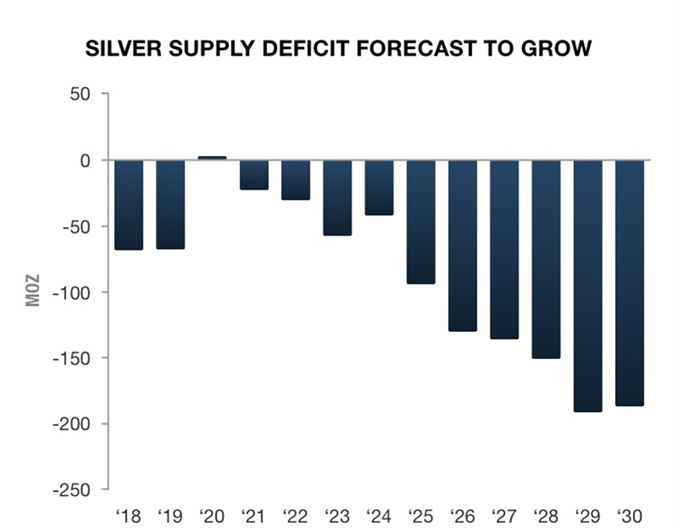
The Silver Institute’s data is unambiguous: we are in a structural deficit. Global primary silver production stands at approximately 830 million ounces annually, yet demand—driven by solar, electric vehicles, and now an accelerating military doctrine shift toward mass-produced drones and interceptors—consistently outpaces supply. Closing this gap requires a 20% increase in global output, a target that cannot be met by existing production alone.

What amplifies this dynamic is the end-of-life cycle now approaching for several primary silver mines in Mexico, the largest source of silver imported to the United States. That depletion, combined with the multi-year deficit already baked into the market, has inventory managers at the LBMA and COMEX watching their stockpiles closely. Daniel Ghali at TD Securities has publicly stated that these inventories could be exhausted by mid-2026. If accurate, it is a hard deadline. A deficit of this magnitude, meeting a supply wall of this severity, could create a window for development. That window may not stay open indefinitely.

Source: The Money Show / Silver Institute, BMO Capital Markets.

Paper Markets vs. Physical Fundamentals

Silver’s spot price has oscillated between $70 and $120 per ounce in early 2026, a volatility that masks an important bifurcation. The “paper” market—ETFs, COMEX futures, equity indexes—responds to macro headwinds: Fed interest rate policy, USD strength, inflation narratives. These are real, but they are transient.

The “physical” market is different. Industrial demand for silver in solar panels, EV battery contacts, and military applications is not discretionary. It cannot be hedged away or deferred by rate cuts. As inventory depletes and supply remains constrained, physical demand may exert upward pressure independent of macro sentiment. We are already seeing signs of this playing out: strategic buyers are accumulating, premiums over spot are widening, and supply contracts are tightening.

This distinction matters for the PEA. A preliminary economic assessment is built on long-term price assumptions and demonstrable demand fundamentals. When you are evaluating a large-scale primary silver deposit in a structural deficit environment, those fundamentals provide a credible foundation for analysis.

The Defense Industrial Base Imperative

Apollo became a member of the U.S. Defense Industrial Base Consortium (DIBC) precisely because silver’s role in military production has shifted. The doctrine pivot toward distributed, mass-produced interceptors and drone systems—rather than legacy platforms—demands a secure, domestic supply chain. That demand is now policy-backed.

Silver is no longer a commodity trading on industrial demand alone. It is a strategic material. Calico’s location in San Bernardino County, within the continental United States, with demonstrated resources of barite and zinc adding further critical mineral value, positions the asset as a potential cornerstone of domestic supply resilience. This is the kind of project that may benefit from policy tailwinds. And those tailwinds are now measurable.

The PEA as Inflection Point

A PEA is the essential first step in translating a mineral resource into a functioning mining operation. While our Mineral Resource Estimate tells us what’s in the ground at Calico, the PEA answers the critical question: how do we develop it most effectively, economically and with minimal environmental impact as possible while maximizing benefits to the local economy as well as supporting the growing national interest in independent critical minerals supply? It brings together geology, metallurgy, engineering, and economic analysis to establish an initial development framework. It assesses mine design options, processing approaches, and provides initial estimates of capital requirements and operating costs.

Equally important, the additional technical work we’re conducting in parallel—including metallurgical and geotechnical programs —will be used to aid towards longer term inputs for more detailed economic and engineering assessments down the line. This reduces uncertainty and points us toward the next critical milestones: Pre-Feasibility and Feasibility studies.

By advancing through these development gates, Calico may be increasingly well-positioned to respond to a market in which the demand for silver is growing. Importantly, Calico is dominantly driven by its silver resource, unlike most other operations where silver is produced as a by-product of other mining operations. This constraint limits the industry’s ability to increase supply in response to higher silver prices, which is precisely where primary silver projects like Calico become strategically important.

Why now? Because the current market window is real. The policy environment is supportive. And the potential advantage of being first to a shovel-ready permitted primary silver project in the United States, in a structural deficit environment, compounds daily.

Conclusion

The forces converging on silver in 2026 appear increasingly structural. Supply deficits, tightening inventories, and supportive US policy developments are all contributing to a strengthing long-term outlook. At the same time, the industrial-plus-strategic demand case appears to be strengthening month by month.

The PEA represents our commitment to converting Calico’s significant resource into a development-ready asset within a timeframe that aligns with the market opportunity. We will provide regular updates as SLR advances this work, and as we continue to build the social license foundation at Cinco de Mayo.

If you have questions about our strategy, the PEA timeline, or our positioning within these macro forces, please reach out to Richard Matthews, our investor relations contact, at info@apollosilver.com or +1 604 428 6128.

Ross McElroy President and CEO, Apollo Silver

Forward-Looking Statements:

This blog contains “forward-looking statements” and “forward-looking information” within the meaning of applicable Canadian securities legislation (collectively, “forward-looking statements”). All statements, other than statements of historical fact, are forward-looking statements, including, without limitation, statements regarding: the advancement of the Company’s Calico project; the timing, scope and outcomes of the preliminary economic assessment (“PEA”) and subsequent technical studies; anticipated permitting developments and regulatory support; expectations regarding silver supply and demand fundamentals; projections regarding global silver production deficits and inventory levels; the role of silver in industrial and defense applications; and the Company’s ability to position Calico as a development-ready, domestically significant critical mineral project.

Forward-looking statements are often, but not always, identified by the use of words such as “anticipate”, “believe”, “plan”, “estimate”, “expect”, “target”, “potential”, “will”, “may”, “should”, “could” and similar expressions. These statements are based on a number of assumptions, including, but not limited to: continued demand for silver driven by industrial and strategic applications; the accuracy of market data and third-party forecasts; the availability of financing; the timely completion of technical studies; and the continuation of supportive regulatory and policy frameworks in the United States.

Forward-looking statements are subject to known and unknown risks, uncertainties and other factors that may cause actual results to differ materially from those expressed or implied by such statements. These risks and uncertainties include, among others: volatility in commodity prices; changes in market conditions; uncertainties related to mineral resource estimates; risks associated with exploration, development and permitting; delays in technical studies; changes in government policy or regulation; reliance on third-party data; and general economic, market and business conditions.

Readers are cautioned not to place undue reliance on forward-looking statements. The Company does not undertake any obligation to update or revise any forward-looking statements, except as required by applicable law.

Aggregated Content

This article was imported from an RSS feed. Content and accuracy are the responsibility of the original publisher.