
Updated March 2026
Canada's Top 10
Hydroelectric Dams
Canada is one of the world's great hydro superpowers — generating roughly 60 per cent of its electricity from flowing water, ranking third globally behind China and Brazil.
Robert-Bourassa Generating Station (LG-2)
Location
James Bay, Quebec
Capacity
7,722 MW
Owner
Hydro-Québec
Built
1974–1981
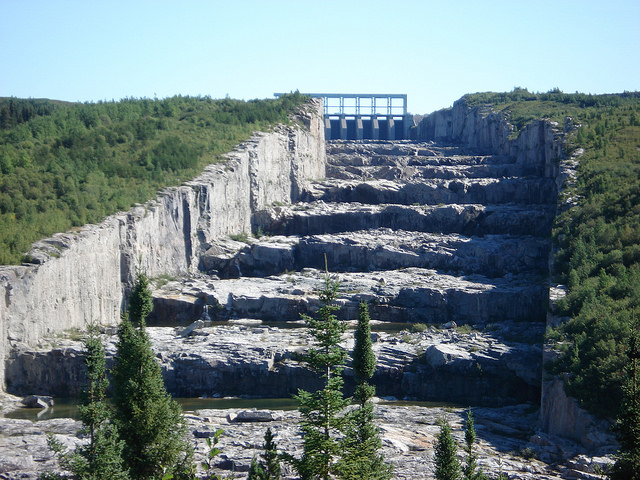
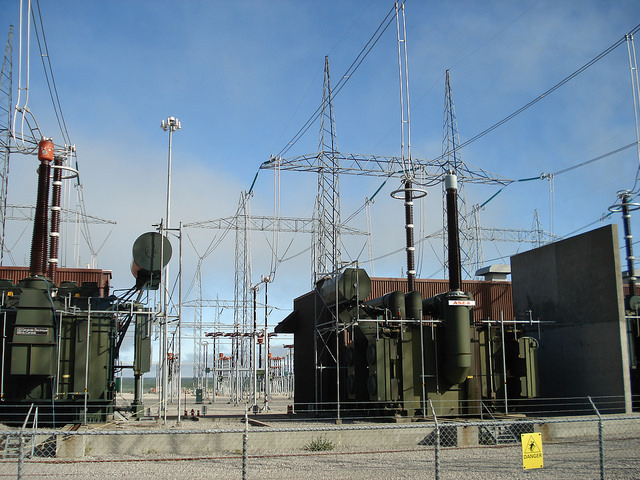
The 7,722-MW Robert-Bourassa hydroelectric generating station is located on the La Grande River in northern Quebec. At 162 metres high and 2,835 metres wide, it is Canada's largest hydro project, the world's ninth largest, and the world's largest underground generating station at 137 metres below ground.
The project's 53-storey dam was constructed in James Bay, and its iconic spillway channels 17,600 cubic metres per second down 10 gigantic concrete steps, each the size of two football fields. This design, nicknamed "the giant's staircase," slows the water and prevents erosion. The reservoir covers 2,815 square kilometres and contains 61 billion cubic metres of water — enough for every person on Earth to draw 10,000 litres before it ran dry.
Engineering Note
The generating station is equipped with a surge chamber — a gigantic underground chamber that acts as a shock absorber for the dramatic pressure variations that occur when turbines are started up or shut down. Water rises in the chamber rather than surging back toward the turbines.
Churchill Falls Generating Station
Location
Newfoundland & Labrador
Capacity
5,428 MW
Owner
CF(L)Co (Hydro-Québec / NL Hydro)
Built
1967–1974
The 5,428-MW Churchill Falls generating station on the Churchill River is the second-largest hydroelectric power plant in Canada and the 10th largest in the world. Its reservoir is contained behind 88 rock-filled dikes rather than a dam, and the underground powerhouse consists of 11 Francis turbines, each rated at 493.5 MW.
The underground machine house was hollowed out of solid granite 305 metres under the earth — at the time of construction, the world's largest. It is three times as long as a football field, as tall as a 15-storey building, and held together with 11,000 steel rock bolts ranging from 11 to 25 feet in length. The Smallwood Reservoir covers 5,698 square kilometres.
Engineering Note
It took 6,300 workers five years non-stop to construct Churchill Falls, and the first two generating units delivered power five months and three weeks ahead of schedule.
2025–2026 Update
In December 2024, Newfoundland and Labrador and Quebec announced a landmark tentative deal to renegotiate the controversial 1969 power contract. The new price of 5.9 cents per kWh would net Newfoundland and Labrador approximately $1 billion per year until 2041, rising to $2 billion per year thereafter, with the agreement running until 2075. As of early 2026, both provinces are working to finalize a binding agreement.
La Grande Complex (2A, 3, and 4)
Location
James Bay, Quebec
Capacity
16,527 MW (combined)
Owner
Hydro-Québec
Built
1974–1986
James Bay is home to 11 hydroelectric projects, including La Grande-2A (2,106 MW), La Grande-3 (2,417 MW), and La Grande-4 (2,779 MW). Covering a combined area the size of New York State, the James Bay Project has a combined 16,527-MW capacity — approximately 40 per cent of Quebec's peak electricity load.
La Grande-4 is Canada's third-largest individual hydroelectric project. The dam stands 125 metres high, spans 3,800 metres and has a spillway capacity of 7,335 cubic metres per second. Together, the eight power stations of the La Grande Complex produce an average of 83 terawatt hours per year.
Engineering Note
The spillways at La Grande-3 and La Grande-4 have a curved, ski-jump design with an upward lip that projects the jet of water dozens of metres into the air. This dissipates part of the water's energy and prevents structural damage to the dam and riverbed below.
W.A.C. Bennett Dam
Location
Hudson's Hope, B.C.
Capacity
2,876 MW
Owner
BC Hydro
Built
1963–1968
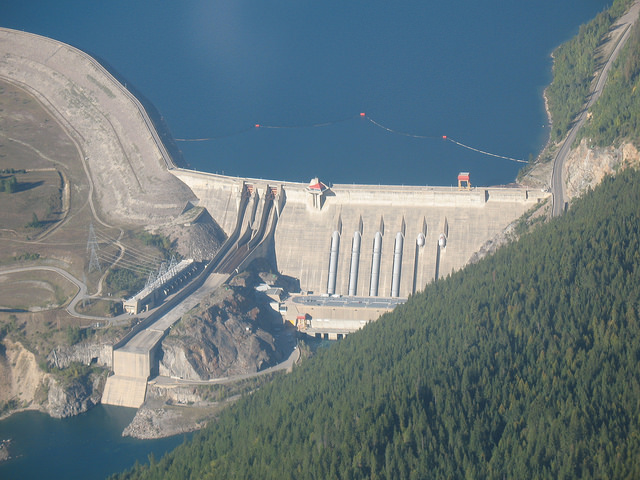
At 183 metres high, the W.A.C. Bennett Dam on the Peace River is one of the world's highest earth-filled dams. It spans 2,068 metres to create Williston Lake, Canada's third-largest artificial lake.
In the 1950s, Ray Williston proposed creating the "Power Trench" by turning sections of the Peace and Columbia river basins into power generation. The resulting Gordon M. Shrum generating station is located 150 metres below ground and houses 10 generating units.
Engineering Note
Units 1 through 5 have undergone complete refurbishment and upgrades, increasing the generating capacity of each unit by as much as 17 per cent. The dam was selected from 12 possible sites 22 kilometres west of Hudson's Hope.
Revelstoke Dam
Location
Revelstoke, B.C.
Capacity
2,480 MW (5 units)
Owner
BC Hydro
Built
1984
The Revelstoke Dam spans the Columbia River five kilometres north of Revelstoke, B.C. The complex includes the 175-metre concrete gravity dam, a 122-metre-high earthfill dam on the west bank and a powerhouse in the riverbed. Five generating units run out of the powerhouse, each with a capacity of approximately 460 MW.
The dam creates a 130-kilometre reservoir extending to the tailwaters of the Mica Dam. Regulated release water from Mica provides almost three-quarters of the inflow, meaning Revelstoke operates as a run-of-the-river plant, with normal maximum reservoir fluctuations of 4.5 metres.
Engineering Note
A fifth generating unit was added in 2011, extending the station's capacity from its original four turbines.
2025–2026 Update
In 2025, BC Hydro formally approved the addition of a sixth unit. Construction on Unit 6 is set to begin in spring 2026, with the new 500-MW turbine expected to be operational by December 2032. This will bring total capacity to approximately 2,980 MW — enough additional power for roughly 200,000 homes.
Beauharnois Generating Station
Location
Beauharnois, Quebec
Capacity
1,912 MW
Owner
Hydro-Québec
Built
1930–1961
Constructed over a 30-year period, the Beauharnois Hydroelectric Power Station is located on the Saint Lawrence Seaway, just 45 minutes from Montreal. Its exceptional Art Deco architecture earned it designation as a National Historic Site.
Beauharnois' 36 generating units spread out over one kilometre make it Hydro-Québec's most powerful run-of-river project and one of the largest of its kind in the world.
2025–2026 Update
Historical note: the dam's early history is riddled with political scandal. The Beauharnois Light, Heat, and Power Company gifted the federal Liberal party $700,000 leading up to the 1930 election in exchange for the right to alter the St. Lawrence River's flow. The scandal eventually led to the nationalization of the utility and the establishment of Hydro-Québec.
Daniel-Johnson Dam / Manic-5
Location
Manicouagan, Quebec
Capacity
2,660 MW (combined)
Owner
Hydro-Québec
Built
1959–1970
The Daniel-Johnson Dam comprises 14 buttresses and 13 arches stretching across the Manicouagan River. It supplies water to the Manic-5 and Manic-5 PA power houses with a combined capacity of 2,660 MW. At 214 metres tall, 1,314 metres long, and containing 2,200,000 cubic metres of concrete, it is the largest multiple-arch-and-buttress dam in the world.
The dam's design uses less concrete than a gravity or embankment dam, and its composition was selected to withstand constant freezing and thawing. Of its 14 buttresses, the two forming the centre arch are 162 metres apart, and at its thickest point, the dam is 22.5 metres wide.
Engineering Note
The arches absorb pressure from the water behind the dam and transfer it to the buttresses and then the foundation — a structurally elegant approach that maximizes strength while minimizing material.
Sir Adam Beck I and II
Location
Niagara Falls, Ontario
Capacity
2,047 MW (combined)
Owner
Ontario Power Generation
Built
1922 (I) / 1954 (II)
The Sir Adam Beck Generating Stations divert water from the Niagara and Welland rivers above Niagara Falls. Beck I first produced energy in 1922 with 10 generators. Beck II came online in 1954, with water diverted via two eight-kilometre tunnels running under the city of Niagara Falls.
Between 2003 and 2013, a major civil engineering upgrade added a 12.7-metre-diameter, 10.2-kilometre-long tunnel to divert water to 16 generators, increasing capacity by 150 MW — enough to power 160,000 homes.
Engineering Note
In 1965, an incorrect protective relay setting at one of the Adam Beck II transmission lines triggered the major Northeast Blackout, causing cascading failures that affected more than 30 million people for approximately 12 hours.
2025–2026 Update
In 2025, Ontario Power Generation and GE Vernova began a 15-year, $1-billion refurbishment of the entire Sir Adam Beck complex. The project will overhaul all 26 units at Beck I, Beck II, and the Beck Pump Generating Station, extending the life of the complex and adding approximately 50 MW of new capacity.
Kettle Generating Station
Location
Gillam, Manitoba
Capacity
1,220 MW
Owner
Manitoba Hydro
Built
1966–1974
The Kettle Generating Station is a run-of-river station located on the lower Nelson River, about six kilometres northwest of Gillam. Twelve 102-MW propeller turbine generators are housed in the power house, with each turbine discharging up to 270 cubic metres per second.
The power house covers 43 per cent of the river's 885-metre width, the spillway covers 22 per cent, and the earth-filled structure covers the remaining 35 per cent. Eight floodgates on the spillway can discharge water at up to 8,349 cubic metres per second.
Engineering Note
Construction was carried out in several stages: a circular cofferdam was set on the right side of the river while the power house was built; the river flowed through the power house while the spillway was constructed; then the earth-filled section completed the dam.
Keeyask Generating Station
Location
Northern Manitoba
Capacity
695 MW
Owner
KHLP (Manitoba Hydro + 4 First Nations)
Built
2014–2022
The Keeyask Generating Station is a joint effort between Manitoba Hydro and four First Nations — Tataskweyak Cree Nation, War Lake First Nation, York Factory First Nation, and Fox Lake Cree Nation — working together as the Keeyask Hydropower Limited Partnership (KHLP).
The project is located on the lower Nelson River, 725 kilometres northeast of Winnipeg. North, central, and south dams were constructed through the Gull Rapids, founded on bedrock as zoned earth embankments with an impervious core, granular filters, and outer rockfill shells. The spillway is a concrete overflow type with seven bays fitted with motorized vertical lift gates.
2025–2026 Update
The first of seven generating units entered service in February 2021, and all seven were fully commissioned by March 2022 — roughly two years behind the original 2019 target. The final cost of $8.7 billion significantly exceeded the original $6.5-billion estimate. The station is now fully operational and producing clean electricity for Manitoba's grid.
Honourable Mention
Site C Clean Energy Project
Location
Peace River, B.C.
Capacity
1,100 MW
Annual Output
5,100 GWh
Cost
$16 billion
Canada's newest major hydroelectric facility. BC Hydro's first generating unit came online in October 2024, and the sixth and final unit was commissioned in August 2025, bringing the station to its full 1,100-MW capacity — enough to power roughly 500,000 homes. Located 83 kilometres downstream from the W.A.C. Bennett Dam, Site C is the costliest dam in Canadian history at $16 billion, far exceeding its original $6-billion estimate.
Looking Ahead
Canada's Hydroelectric Future
With more than 82,000 MW of installed capacity and an estimated 155,000 MW of undeveloped technical potential, Canada's waterpower sector remains the backbone of the country's electricity system and a cornerstone of its clean-energy ambitions.
Revelstoke Unit 6
BC Hydro begins construction on a 500-MW sixth unit in spring 2026, operational by December 2032.
Sir Adam Beck Refurbishment
OPG's $1-billion, 15-year overhaul of all 26 units at Niagara Falls — adding 50 MW of new capacity.
Churchill Falls Renegotiation
A tentative deal could net Newfoundland and Labrador $1–$2 billion per year through 2075.
Indigenous Hydro Projects
The 7.5-MW Innavik project in Inukjuak and a 17-MW facility at Matawin both received federal funding in 2025.
As Canada works toward a net-zero electricity grid, hydropower — reliable, dispatchable, and low-emission — will continue to do the heavy lifting.
In This Article
By Province
Related Guides
Canada Finally Has a Sovereign Wealth Fund. Mining and Energy Are at the Top of the List.
More than 3 days ago
Canada's Critical Minerals: The Resource Superpower
More than 3 days ago
How Agnico Eagle Scored Millions in Free Advertising at the Blue Jays World Series Game 7
More than 3 days ago
How Sacred Soil Is Changing the Game for Orphan Wells and Industrial Abandonments
More than 3 days ago